
[Insight] 2026 K-Security Market Growth of 17.1% and Complete Guide to SOAR
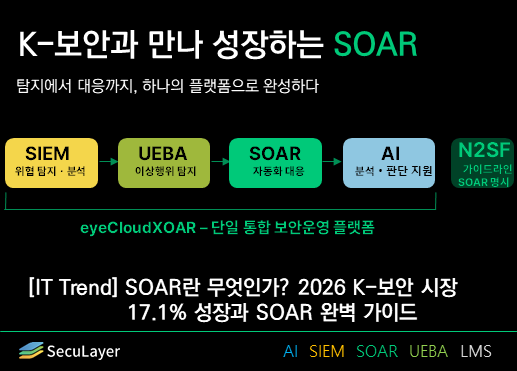
🔐 Special Feature on SOAR by Security World, Reinterpreted from SecuLayer's Perspective!
Hello, we are SecuLayer, an AI-based big data analysis and autonomous security operations company.
✅ What if less than 10% of security alerts are actually responded to while they keep piling up?
There is a somewhat shocking statistic.
According to a survey conducted in August 2026 by Security News and Security World with 1,032 domestic security experts, 39.6% responded that the actual response rate to daily security alerts is less than 10%.
In other words, more than 9 out of 10 security alerts are simply ignored.
This is not a problem with the system itself, but rather a limitation of the structure where humans must check and assess each incoming alert individually.
To address this issue, SOAR has emerged.

SOAR (Security Orchestration, Automation, and Response) is a security platform that orchestrates different security solutions into one, automating the process from threat detection to response.
To put it simply:
SIEM collects logs from various security devices and raises alerts when it detects "anomalies."
SOAR receives those alerts and automatically executes actions according to a playbook, determining "what actions to take on which devices."
Since Gartner first introduced the concept of SOAR in 2015, it has rapidly evolved to meet market demands.
And now, in 2026, its growth in South Korea is reaching a significant turning point.

Data from global market research firms illustrates just how steep the growth rate of the SOAR market is.
Global SOAR Market: $1.6 billion in 2023 → $5.7 billion in 2032 (15% annual growth)
South Korea SOAR Market: Approximately 53.6 billion KRW in 2024 → Approximately 137.7 billion KRW in 2030 (annual growth of 17.1%)
Notably, the growth rate of the South Korean market exceeds the global average.
This is due to the interplay of domestic security regulatory environments and demand from the public and financial sectors, creating a stronger growth momentum.
SecuLayer has diagnosed the current state of the market in this special feature article.
"The market has completely settled into a 'necessary integrated monitoring platform' beyond just the 'interest stage,' and there is an increasing demand for integrated security operation platforms that combine SIEM and SOAR. While past implementations were mainly centered around large public institutions or enterprises, the adoption base is now expanding to include finance, defense, local governments, and private companies."

In September 2025, the National Intelligence Service officially mentioned SOAR in the 'National Network Security Framework (N2SF) Security Guidelines Interpretation Document.'
The document states, "Implement real-time responses to security events in conjunction with SIEM, UEBA, SOAR, etc."
Why is this important?
N2SF is a system that classifies information into C (Confidential), S (Sensitive), and O (Public) grades for differential control, increasing the number of security control items from the existing 176 to over 260. A system that processes different response procedures by grade in a consistent and automated manner has become essential.
National-level guidelines are making SOAR a de facto essential component rather than just a recommendation.
SecuLayer has accurately pinpointed the core of this change.
"The interest from public institutions is high because SOAR integrates and controls existing security assets without replacing them, using APIs. The market demand is shifting from merely adopting a single SOAR to inquiries about large-scale advanced projects that integrate SIEM + UEBA + SOAR into a single layer or the entire security operation platform of an organization."
✅ The Real Reasons for Adopting SOAR in the Field
In this survey, the reasons respondents cited for adopting or considering SOAR (multiple responses allowed) reflect the urgency in the field.
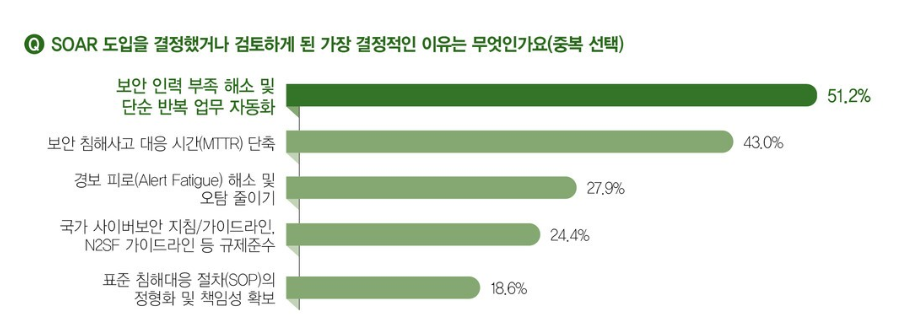
▲SOAR Solution User Survey [Source: Security News·Security World]
Ultimately, security personnel hope that "machines will handle the overwhelming amount of alerts that humans cannot manage."
And this demand is creating a structure that directly impacts budgets.
✅ What Makes SOAR Implementation Difficult?
There are also practical challenges. The biggest obstacles to SOAR implementation identified by survey respondents are as follows.
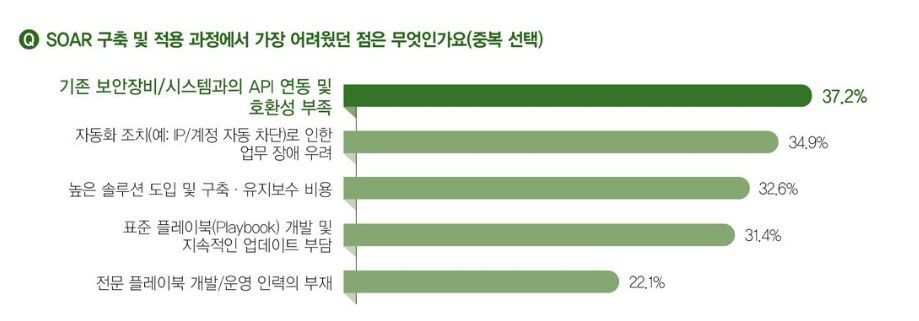
▲SOAR Solution User Survey [Source: Security News·Security World]
Among these, the issue of Korean-style playbooks deserves special attention.
Simply adopting overseas standard procedures does not work.
This is because each domestic organization has different combinations of equipment, log fields, approval structures, personal information policies, and network separation environments.
SecuLayer understands this better than anyone.
"Understanding and coordinating Korean security monitoring administration, such as approval waiting, automatic notification to related agencies, and user clarification procedures, is necessary."
The operational experience accumulated from thousands of sites is the source of this 'Korean know-how.'

The evolution of SOAR does not stop here. AI is elevating the potential of SOAR to a new level.
Existing rule-based playbooks are strong against known threats but require manual updates every time new or mutated attacks emerge.
When generative AI and LLM technology are combined, the following becomes possible:
AI automatically summarizes and organizes large volumes of security events
AI analyzes correlations between complex logs
Recommends action plans based on historical data
Reduces analyst workload through natural language Q&A
SecuLayer is also providing clear answers in this direction.
By advancing into an integrated security operation platform that combines SIEM, UEBA, and SOAR,
we focus on connecting the flow from collection, normalization, and correlation analysis to ticketing, playbooks, and actual device actions.

It is a natural progression that SecuLayer's eyeCloudXOAR is introduced in this special feature by Security News·Security World.
eyeCloudXOAR is, as the name suggests, eXtended SOAR, meaning it is an extended SOAR.
It is the representative K-SOAR in South Korea that completely integrates SIEM, SOAR, UEBA, and AI into a single platform according to business processes.
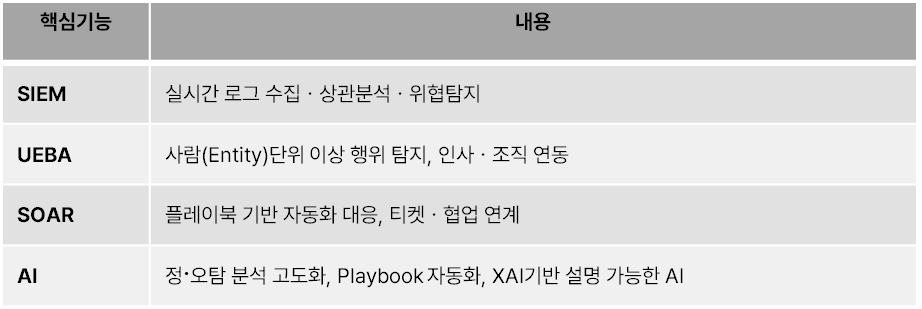
In particular, the advanced version of eyeCloudXOAR has officially integrated UEBA, extending the monitoring targets from devices and IPs to people (Entities).
Seamlessly incorporating Korean security monitoring administrative procedures such as approval processes, notifications to related agencies, and user clarifications into the playbook flow is also a unique strength of eyeCloudXOAR.
Operational experience validated at over 5,000 sites in South Korea
Ranked #1 in integrated security management market share for four consecutive years
Holds 74 patents
All of this indicates that eyeCloudXOAR is not just a simple product but a platform that has evolved alongside the domestic security field.
✅ In Conclusion — From Event Handling Organization to Threat Response Organization
The article from Security News concludes as follows.
"Ultimately, SOAR is about delegating repetitive tasks to machines so that humans can focus on decision-making tasks.
Isn't now a great opportunity for domestic security monitoring to transform from an 'event handling organization' to a 'threat response organization'?"
SecuLayer will continue to provide ongoing security services to our customers at the center of this transformation with eyeCloudXOAR.
Moving away from being overwhelmed by alerts, we aim to create an environment where we can focus on real threats; this is the future of security that eyeCloudXOAR is building.
Learn More About eyeCloudXOAR → https://www.seculayer.com/ko/product/security
Related News
![[ISEC 2026 On-Site Sketch] A New Partnership Between AI and Humans! The Future of Next-Generation Security Monitoring and Supply Chain (SBOM) Security Presented by SecuLayer](/_next/image?url=https%3A%2F%2Fd1dvcjcxccygto.cloudfront.net%2Fuploads%2F1787117139602-156677098.png&w=3840&q=75)
[ISEC 2026 On-Site Sketch] A New Partnership Between AI and Humans! The Future of Next-Generation Security Monitoring and Supply Chain (SBOM) Security Presented by SecuLayer
Hello, this is SecuLayer. SecuLayer successfully participated in the ‘ISEC 2026 (20th International Security Conference)…
![[Event Participation News] ISEC 2026 (20th International Security Conference)](/_next/image?url=https%3A%2F%2Fd1dvcjcxccygto.cloudfront.net%2Fuploads%2F1784784479791-415139056.png&w=3840&q=75)
[Event Participation News] ISEC 2026 (20th International Security Conference)
SecureLayer will participate in the ISEC 2026 event, which will be held at COEX Hall D from August 11 (Tuesday) to Augus…

K-Security Alliance Formed Between Leading Domestic Companies SecuLayer and QuadMiner, Strategic Business Agreement Signed
-Proposing an AI-based 'Complete Security Defense System' through context data-driven security observability and integra…