
[Insight] From Detection to Response: Integrated Security Operations Strategy to End Alert Overload with SIEM and SOAR
[Insight] From Detection to Response: Integrated Security Operations Strategy to End Alert Overload with SIEM and SOAR
🔐 Four-Step Connection Architecture and Platform Selection Criteria for Seamless Security Monitoring
While the number of security devices has increased, many organizations still have the same number of monitoring personnel. Alerts pile up by the thousands or tens of thousands each day, and the responsible personnel spend their days sorting through them to identify real threats. Many security leaders now shake their heads at the question, "Will adding more devices improve security?"
Today, we will summarize the roles of the two pillars of security operations, SIEM and SOAR, where the market is heading by 2026, and how to connect the two solutions to maximize operational efficiency.
Executive Summary Key Summary
Bottleneck in Monitoring: Although the number of security devices has increased, the monitoring personnel remain the same. In environments where detection (SIEM) and response (SOAR) are separated, delays in response due to manual processes and fatigue from false positives accumulate.
Changes in Market and Regulations: The global security market is converging into integrated platforms combining SIEM, SOAR, UEBA, and AI, and the national network security framework (N2SF) also requires real-time interconnected responses as a prerequisite.
Solution Strategy: Before implementation, establish 'standardization of response procedures' and 'criteria for phased automation', and choose a platform where collection, behavioral analysis, AI judgment, and automated response are linked as a single pipeline.

SIEM (Security Information and Event Management) is a system that collects and analyzes scattered security logs from firewalls, servers, endpoints, and the cloud, and triggers alerts when anomalies are detected. In simple terms, it acts as a control tower monitoring the entire organization.
SOAR (Security Orchestration, Automation and Response) is a system that receives those alerts and automatically takes actions on various security devices according to predefined response procedures (playbooks). You can think of it as the response team that actually deploys based on signals from the control tower.
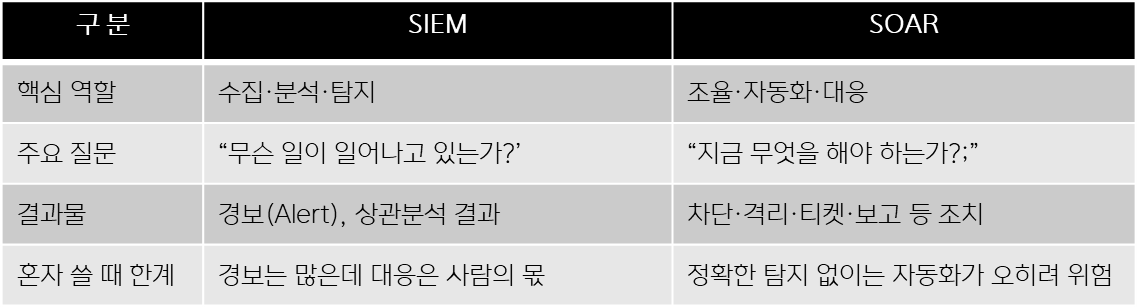
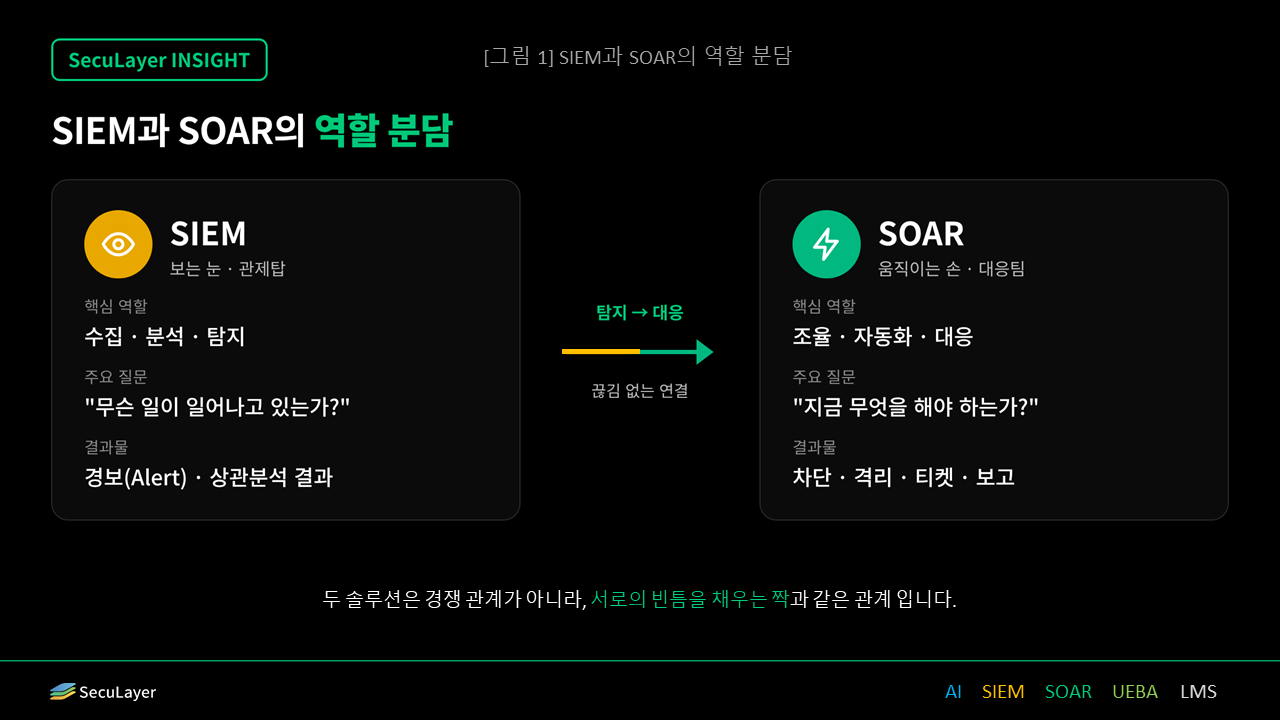
[Figure 1] Role Distribution of SIEM and SOAR
Having only SIEM leads to a buildup of alerts but delayed actions, while having only SOAR weakens the basis for determining what to respond to. Operating the two as separate systems introduces manual intervention between detection and response, causing critical time to slip away.

✅ ① Monitoring Fatigue Due to Alert Overload and False Positives
The volume of security events increases every year, but the number of skilled personnel to review them does not easily grow. As a result, many alerts pass by without proper review, and the most time is spent filtering out false positives. If detection is not accurate, automation cannot be trusted.
✅ ② Convergence of Global Market and Domestic Competitive Landscape
The global market research firm Frost & Sullivan identified the trend of the integration of SIEM, UEBA, SOAR, and AI into a single platform as a key trend in its June 2026 report, predicting that the modern SIEM market will grow at an average annual rate of 13.7% from 2024 to 2029.
The direction of the domestic security operations solution market is also clear.
Open XDR Type — There is a trend to bundle log management, SIEM, SOAR, and forensics into a single platform, emphasizing interoperability with hundreds of external solutions to target overseas markets.
Autonomous SOC Type — Strategies that emphasize 'autonomous security monitoring' where AI analyzes data and assists in monitoring decisions are also spreading.
Integrated Security Operations Platform Type — This direction aims to integrate SIEM, SOAR, UEBA, and AI into a single platform tailored to domestic public and financial monitoring environments.
Although the terminology differs, the message is the same: "We will bundle tools that were working separately and reduce repetitive tasks with AI." Ultimately, the criteria that the implementing entity should consider are not marketing jargon but whether it operates seamlessly according to 'our organization's monitoring procedures.'
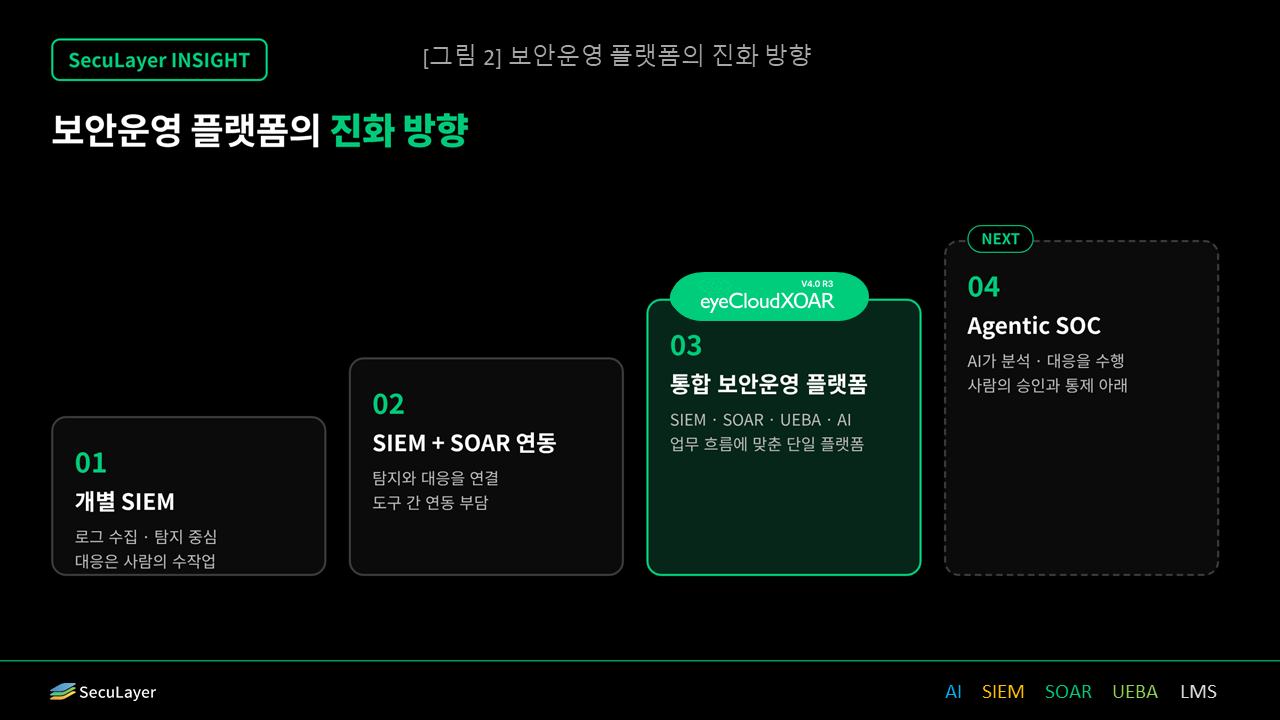
[Figure 2] Evolution Direction of Security Operations Platforms
✅ ③Changes in Regulatory Environment: Mandatory Real-Time Interconnected Response
The guidelines for the national network security framework (N2SF) include provisions for implementing real-time responses to security events in conjunction with SIEM, UEBA, and SOAR. Especially for public institutions, handling detection and response in a consistent and automated manner is becoming a basic requirement.

No matter how advanced an integrated platform is introduced, if the operational standards within the organization are not established, automation will not perform effectively. Before implementation, the following three aspects should be checked first.
Standardization of Response Procedures — Is it documented "who, what, and in what order" handles each type of threat? This serves as the blueprint for the playbook.
Classification of Automation Stages — It is not necessary to automate everything from the start. It is safer to automate low-risk repetitive tasks first and gradually expand to sensitive actions requiring human approval.
Setting Performance Metrics — Define the criteria to quantify improvement effects, such as Mean Time to Detect (MTTD), Mean Time to Respond (MTTR), and false positive rates.

For SIEM and SOAR to synergize, the following four steps from detection to reporting must be connected as a single pipeline.
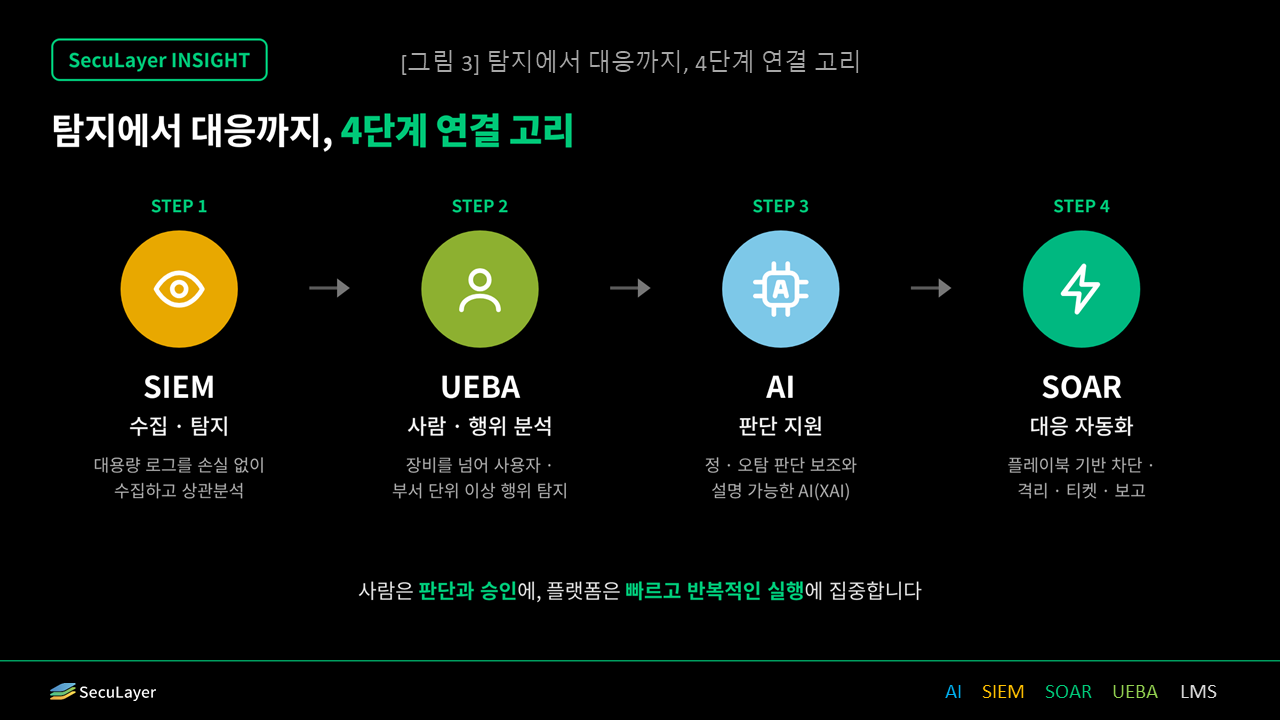
[Figure 3] Four-Step Connection from Detection to Response
✅ Step 1. Accurate Collection and Correlation Analysis (SIEM): Collect large volumes of logs without loss and extract meaningful alerts through multidimensional correlation analysis. The integrity of the data must be supported to ensure the subsequent steps are stable.
✅ Step 2. Behavior-Based Anomaly Detection (UEBA): Account takeovers or insider threats are difficult to capture with existing detection rules. It is necessary to learn the normal behavioral patterns of users and departments to identify abnormal movements.
✅ Step 3. Explainable AI-Based True/False Detection (AI): AI first classifies whether alerts are true or false, helping personnel focus on high-risk threats. The key here is to have an AI that can explain the reasoning behind its judgments, rather than a black-box AI.
✅ Step 4. Playbook-Based Response Automation (SOAR): For validated threats, predefined playbooks automatically perform actions such as blocking firewalls, isolating endpoints, issuing tickets, and reporting results. The structure allows humans to focus on final judgment and approval, while the platform concentrates on fast and accurate execution.

SecuLayer's eyeCloudXOAR is an integrated security operations platform that unifies the four-step connection chain mentioned above.
The latest version, eyeCloudXOAR 4.0 R3, has enhanced its architecture to operate the four core modules of SIEM, SOAR, UEBA, and AI in a single server configuration. It also supports multilingual (Korean, English, Russian) and multi-timezone capabilities per account, allowing for flexible responses in global monitoring environments, and has completed CC recertification as of the current release, ensuring security and reliability.
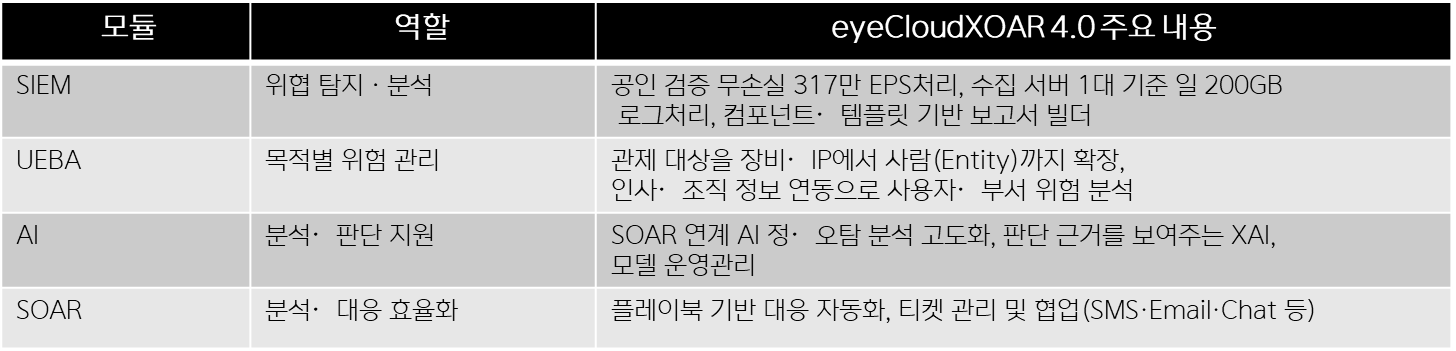
Additionally, R3 supports multilingual (Korean, English, Russian) and multi-timezone capabilities per account, making it usable in global monitoring environments, and has completed CC recertification as of the current release.
✅ Changes in Practical Monitoring Flow
In the eyeCloudXOAR environment, the responsible personnel can initiate analysis simply by asking the AI assistant in natural language, "Summarize the major security events that occurred today."
The AI maintains the context of the conversation, deeply analyzes specific IPs or attack indicators, and immediately links with the SOAR playbook and ticketing system to execute responses, generating final analysis reports automatically.
Completing everything from detection to reporting on a single screen is the practical operational efficiency that SecuLayer has implemented.
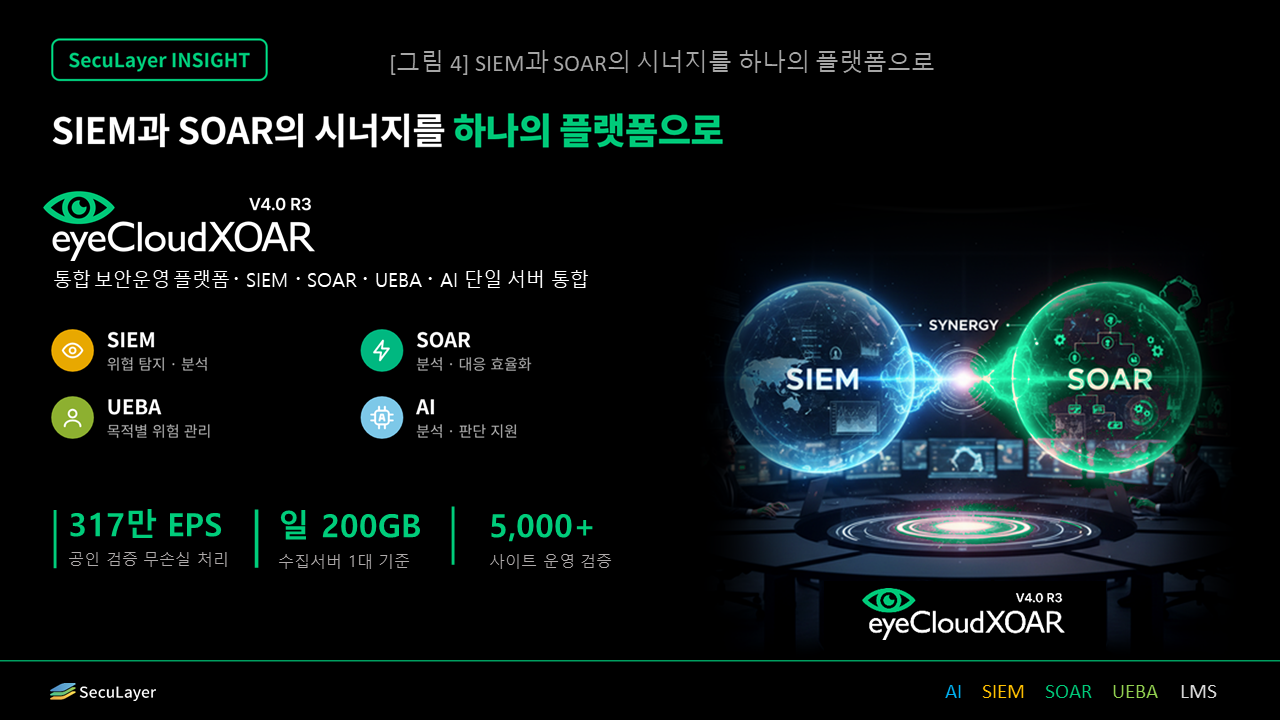
[Figure 4] Synergy of SIEM and SOAR on a Single Platform
✅ Verified Stability and 'Controllable Agentic SOC'
It has been verified for operational stability in over 5,000 sites across public, financial, and enterprise sectors, and is applied in large-scale monitoring sites in collaboration with SK Shieldus, providing close technical support based on national hubs.
Furthermore, SecuLayer is leading the evolution towards Agentic AI-based autonomous security monitoring (Agentic SOC), where AI analyzes and responds independently. The roles and authorities of AI are clearly defined, critical actions require human approval, and the automation area is gradually expanded starting from low-risk tasks to implement safe and reliable autonomous security.

While both SIEM and SOAR are essential solutions individually, true monitoring efficiency is achieved when the two systems are seamlessly connected.
The reason the security market is rapidly restructuring into integrated platforms and AI autonomy by 2026 is also found here.
To build a successful integrated security operations environment, one must look beyond the keywords 'integration' and 'AI'.
It is essential to verify whether our organization's response procedures are standardized, whether the accuracy of detection data is sufficient, and whether the personnel can clearly understand and control AI's judgments.
SecuLayer aims to create an optimal security operations environment where security personnel can focus on higher-level threat assessments while the platform takes responsibility for repetitive executions under the vision of 'a new partnership between AI and humans.'
Are you curious about the integrated platform configuration that suits your organization's monitoring environment?
Source / References
Security World Market, Frost: AI-driven, cloud-native SIEM to define cyber security ops (2026-06-18) — https://www.securityworldmarket.com/me/News/Business-News/frost-ai-driven-cloud-native-siem-to-define-cyber-security-ops
National Intelligence Service, National Network Security Framework (N2SF) Security Guidelines Commentary (2025-09)
SecuLayer eyeCloudXOAR 4.0 R3 Product Introduction Document (2026-08)
Related News
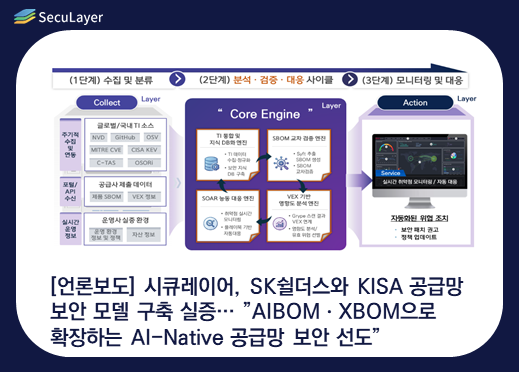
SecuLayer, in collaboration with SK Shieldus, is demonstrating the KISA supply chain security model... "Leading AI-Native supply chain security by expanding into AIBOM and XBOM"
- Presenting the 'AI-Native Supply Chain Security' paradigm and accelerating the roadmap for AIBOM and XBOM expansion - …
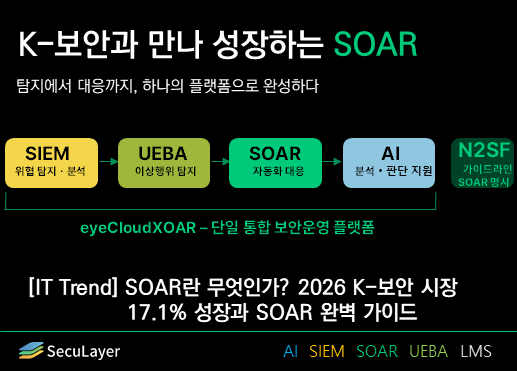
[Insight] 2026 K-Security Market Growth of 17.1% and Complete Guide to SOAR
🔐 Special Feature on SOAR by Security World, Reinterpreted from SecuLayer's Perspective! Hello, we are SecuLayer, an AI…

[ISEC 2026 On-Site Sketch] A New Partnership Between AI and Humans! The Future of Next-Generation Security Monitoring and Supply Chain (SBOM) Security Presented by SecuLayer
Hello, this is SecuLayer. SecuLayer successfully participated in the ‘ISEC 2026 (20th International Security Conference)…